

Average land occupancy currently stands at over 52%, with six clusters still in the infrastructure development phase. While investment potential remains substantial, a number of structural bottlenecks continue to constrain fuller uptake, underscoring the need for long-term and systemic solutions.
New Development Space, Strong Industrial Potential
According to the Department of Industry and Trade, during the 2021–2025 period, the province’s industrial value-added grew at an average rate of nearly 10.7% per year. In 2025, total industrial output was estimated at more than 33 trillion dong (around US$ 1.35 billion), an increase of over 16% year on year, making a significant contribution to GRDP growth and local budget revenues.
The First Provincial Party Congress for the 2025–2030 term set a target of average GRDP growth of 10.5% per year during 2026–2030. Deputy Secretary of the Provincial Party Committee and Chairman of the Provincial People’s Committee Phan Huy Ngoc said industrial development, particularly the attraction of enterprises into industrial parks and industrial clusters, would serve as the main growth driver.
To support this objective, the province is channeling resources into coordinated investment in technical infrastructure, digital infrastructure and administrative reform, with the aim of improving competitiveness and strengthening investor confidence in local industrial clusters.
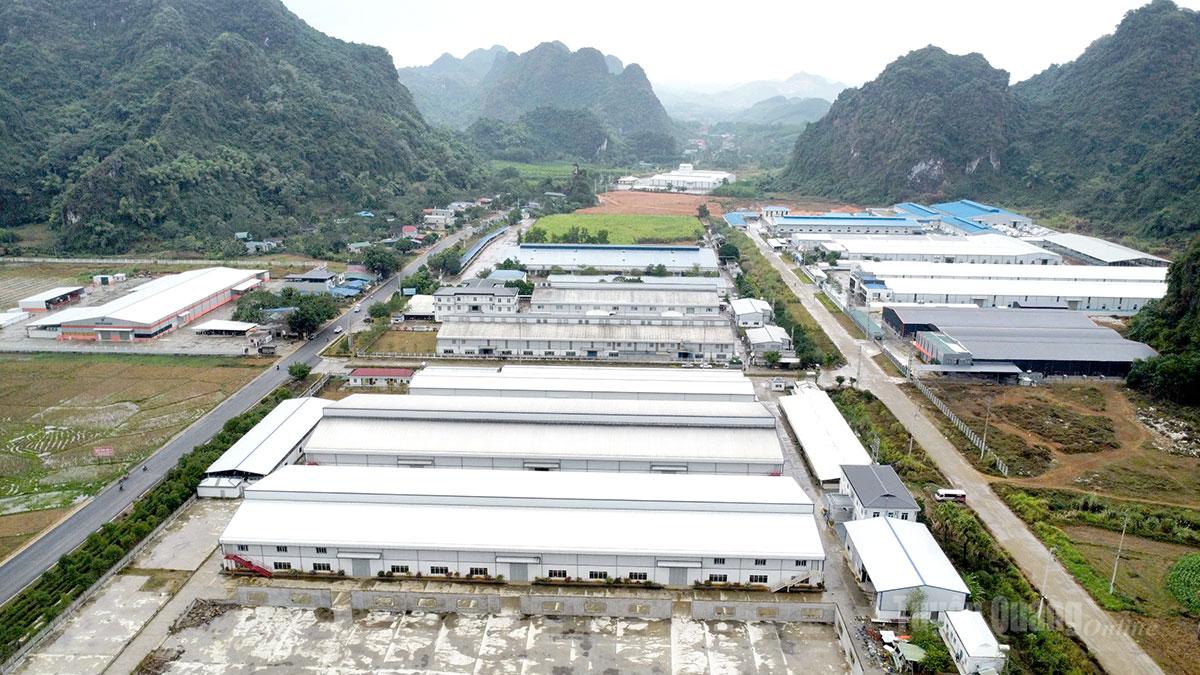
Phuc Ung Industrial Cluster has reached nearly 98% occupancy based on registered investment
Following the administrative merger, Tuyen Quang’s industrial development space has expanded, enabling more efficient use of land, natural resources and labor. Among the 17 established clusters, many have attracted investors in agro-forestry processing, construction materials, textiles and garments, mechanical engineering, and supporting industries.
Several clusters have recorded high occupancy rates, including Phuc Ung (nearly 97%), Thang Quan (nearly 88%), and Minh Son 2 (100%).
Identifying the Bottlenecks
Despite steady growth and strong potential, the development of industrial clusters continues to face persistent challenges.
A major constraint lies in incomplete infrastructure at many clusters. In several cases, development has been limited to basic internal roads and site leveling, while essential facilities, such as centralized wastewater treatment systems, water supply and drainage networks, and fire prevention infrastructure, remain absent or underdeveloped.
Most operational clusters still lack centralized wastewater treatment plants, requiring individual enterprises to install their own systems. This not only raises environmental risks but also reduces the clusters’ attractiveness to large-scale investors with high environmental and compliance standards.
Examples include Km 38 Industrial Cluster in Tan Xa Phin village, Nam Dich Commune, and Tan Thanh Industrial Cluster, established in 2015 and 2017, respectively. To date, neither cluster has seen substantive infrastructure investment, nor attracted secondary projects.
Even at Phuc Ung Industrial Cluster, which has drawn 13 projects and reached nearly 97% land occupancy, a centralized wastewater treatment system has yet to be built. Investors are therefore required to manage waste collection and treatment independently to comply with environmental regulations.
Land clearance remains another prolonged bottleneck. Limited local budget resources, combined with insufficient incentives for infrastructure developers, have slowed progress. Some clusters also face disadvantages in transport connectivity and logistics, further constraining operational efficiency.
As a result, most of the 17 established clusters report occupancy rates below 50%, with several still lacking any registered secondary investment projects.
Removing Barriers, Boosting Investor Appeal
To address these constraints, the province has prioritized further investment in core cluster infrastructure, particularly internal roads, power supply systems, water infrastructure, centralized wastewater treatment facilities, and environmental protection works.
At the same time, authorities are accelerating administrative reform, shortening approval timelines and fostering a more transparent and predictable investment environment.
Tuyen Quang is also pursuing a green and sustainable industrial development strategy, prioritizing projects that apply modern, resource-efficient and environmentally friendly technologies. These criteria will guide project selection in industrial clusters in the coming period.
Mr. Saito Yasushi, General Director of EREX Vietnam Co. Ltd., which has invested in a biomass fuel plant at Long Binh An Industrial Park and a biomass power project at Xuan Van Industrial Cluster, said strong provincial support, particularly in administrative procedures and land clearance, has created favorable conditions for investors. “This demonstrates the province’s strong commitment to industrial development,” he said.
In the coming time Tuyen Quang plans to develop industrial clusters under a regional linkage model, connecting clusters with industrial parks, urban areas and service hubs to form concentrated production zones and gradually increase industry’s share in the provincial economic structure.
As land availability for large, centralized industrial parks becomes increasingly constrained, the effective development of industrial clusters will play a decisive role in achieving the province’s growth objectives. Completing infrastructure, removing bottlenecks and selectively attracting high-quality projects will enable Tuyen Quang’s industrial clusters to secure sustained investment, supporting the province’s ambition to emerge as a key processing hub for forestry and agricultural products in Vietnam’s northern midland and mountainous region.
Nguyen Thanh Hieu
From a Vietnamese article on the Tuyen Quang online
