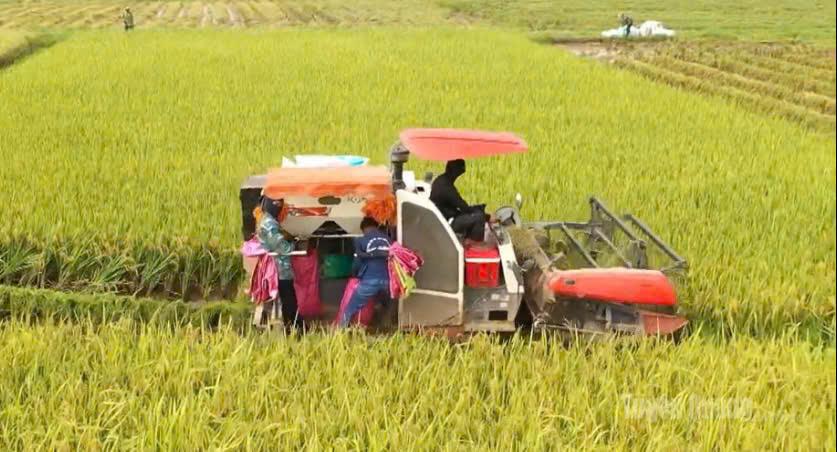
The introduction of machinery contributes to liberating labor for local farmers.
According to a report from the Department of Agriculture and Rural Development, as of the end of 2025, the total number of agricultural machines in the province reached 238,066 units, an increase of nearly 90,000 units year-on-year. This systematic investment in hardware has transformed the landscape of spearhead industries. In cultivation, the mechanization rate for land preparation has surpassed 70%. Farmers have become more proactive in utilizing machinery from sowing to harvesting, significantly reducing post-harvest losses.
Particularly impressive is the dairy industry, with a mechanization rate exceeding 80% through automated milking systems and specialized transport equipment. While the forestry and fishery sectors remain modest, critical stages such as timber harvesting have seen a clear emergence of technological tools in production.
Moving beyond raw production, the province's processing industry has established a robust system. The tea industry stands out with 36 factories and 65 cooperatives. As a result, during the 2021-2025 period, over 27,730 tons of tea were exported, generating over $51.9 million in foreign exchange. Furthermore, forest products reached an export value of $183.6 million, penetrating high-standard markets including the EU, the US, Japan, and South Korea.
To ensure mechanization becomes a primary driver, the province has outlined high-efficiency solutions. Priority will be given to attracting investment into agricultural machinery, preservation systems, and intensive processing to diversify products.
Focus will also be placed on refining infrastructure and developing specialized hubs integrated with logistics and traceability. Additionally, credit support will be intensified to help farmers and businesses boldly invest in modern equipment and advanced machinery.
Nguyen Thanh Hieu
Vietnamese source: Tuyen Quang online