Replacing Cornfields with Valuable Medicinal Crops
In Pho Bang Commune, high-value medicinal plants are steadily replacing traditional corn and vegetable fields. Capitalizing on the cool weather and favorable conditions, local authorities have actively encouraged farmers to shift toward high-efficiency agricultural models tailored to local advantages.
Thao Sia Lenh, a farmer in Pho La Village, previously cultivated a single corn crop per year with minimal financial returns. In 2020, Lenh transitioned 0.5 hectares of his corn land to Paris polyphylla (Seven-leaved Paris) - a rare, high-value medicinal species requiring patience and technical precision. His crop has thriven, and he has begun selectively harvesting rhizomes for sale at approximately 1 million VND per kilogram. Upon full harvest, his 0.5-hectare plot is projected to yield around 500 million VND.
According to Giang Mi Say, Vice Chairman of the Pho Bang People's Committee, Lenh’s success reflects a broader trend across the commune. Pho Bang currently manages nearly 24 hectares of medicinal plants, including Chinese angelica, yam rhizomes, Vietnamese ginseng, and Paris polyphylla. This strategic direction leverages local natural assets while boosting rural household incomes.
Expanding Commercial Cultivation Zones
Tuyen Quang boasts ideal conditions for large-scale medicinal plant production. With diverse topography featuring high mountain ranges and distinct microclimates, the province accommodates various botanical species across different ecological zones. Its natural medicinal resources are rich in species of high medical and economic value, including Chinese angelica, purple cardamom, Stephania root, fleeceflower root, and Gynostemma pentaphyllum. High-value species such as Panax japonica (wild ginseng) and Panax notoginseng have also been successfully trialed with encouraging initial yields.
Official statistics estimate the province’s total medicinal plant area at 22,573 hectares, featuring over 60 plant species under national conservation status. High-demand varieties include lily bulb, woodwardia, Codonopsis, red knotweed, Solomon's seal, honeysuckle, and Schefflera.
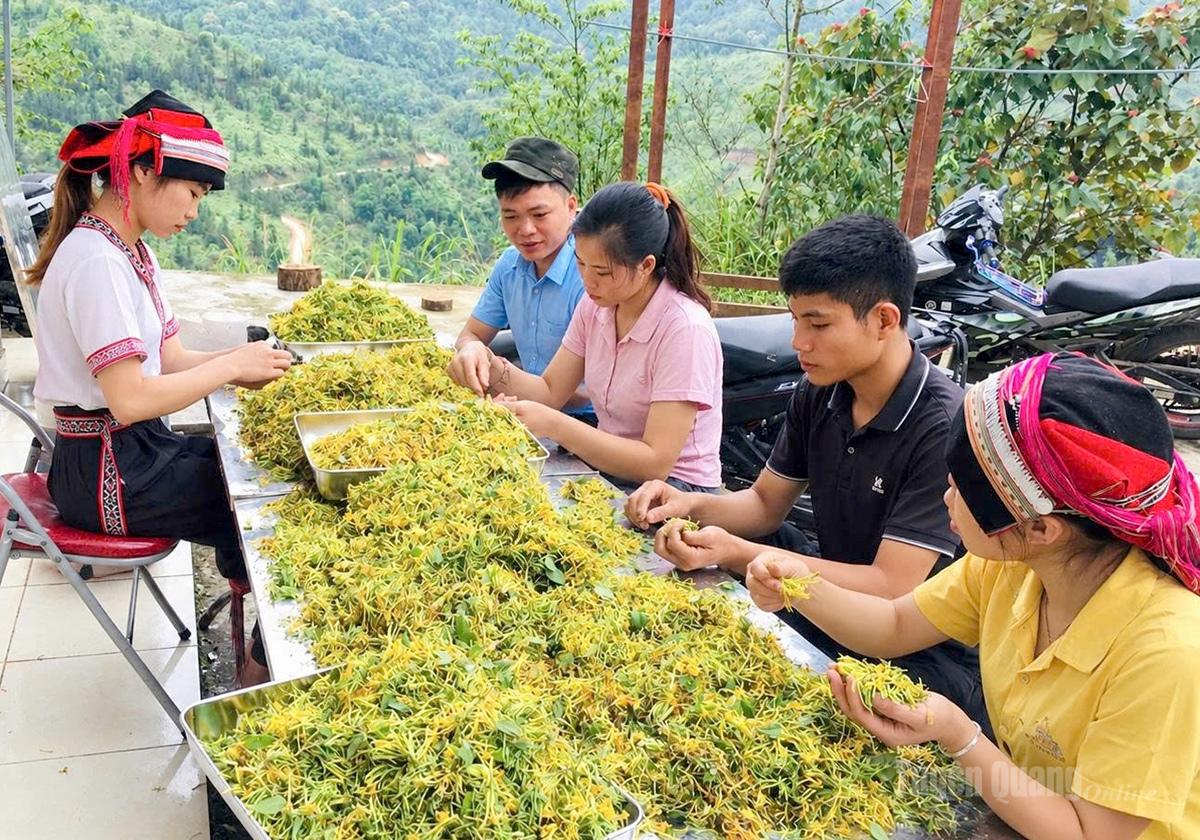
People in Nam Dam Village, Quan Ba Commune, process honeysuckle flower tea
This resource offers Tuyen Quang a strong competitive edge to build commercial medicinal cropping zones linked with processing facilities, maximizing product value and genetic preservation. However, rapid market demand highlights the urgency for sustainable management. Historically, uncoordinated wild harvesting depleted natural populations of rare medicinal plants.
Rising domestic demand for herbal remedies and national priorities for domestic sourcing present a prime opportunity for Tuyen Quang. The province is building concentrated, market-oriented cultivation zones, establishing integrated value chains spanning production, harvesting, primary processing, refining, and distribution. Infrastructure investments and support initiatives under the 2021–2025 development phase have accelerated zone expansions while balancing economic exploitation with conservation.
Giang Duc Hiep, Director of the Provincial Sub-Department of Crop Production and Plant Protection, emphasized that selecting plant varieties aligned with local microclimates is critical for long-term viability, alongside linking farming with processing, distribution, and genetic preservation.
Expanding medicinal crop zones marks a pivotal step in agricultural transformation across the province. By aligning natural ecological advantages with technical precision, structured zoning, processing, and market integration, Tuyen Quang is preserving its precious botanical resources while creating lucrative, sustainable livelihoods for its highland communities.
Nguyen Thanh Hieu
Source: Tuyen Quang online